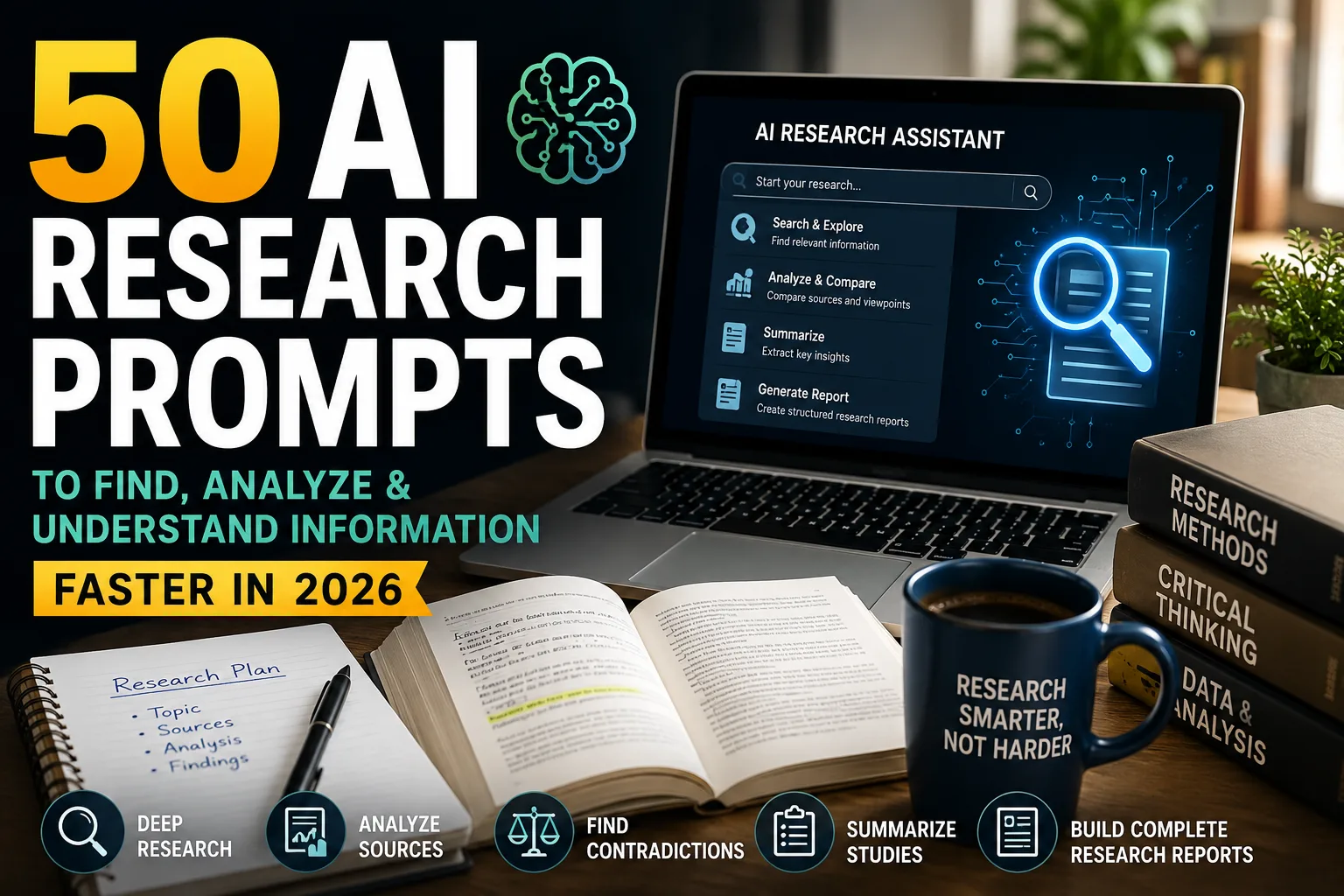
Research has always been the foundation of informed decision-making - but the way we conduct it is changing faster than at any previous point in history. In 2026, artificial intelligence has moved from novelty to necessity inside every serious research workflow. Whether you are a student writing a dissertation, a journalist verifying claims, a business analyst tracking market shifts, or a content creator building topical authority, AI can dramatically reduce the time you spend finding, processing, and making sense of information.
The challenge is not whether to use AI for research. It is how to prompt it correctly. A vague question produces a vague answer. A precise, structured research prompt produces focused, reliable, and actionable output. This article gives you 50 ready-to-use AI research prompts organized into six critical research stages: deep research, comparing sources, finding contradictions, summarizing research, asking follow-up questions, and building research reports.
Every prompt in this collection follows the four-component structure that professional prompt engineers and research teams rely on in 2026 - Role, Context, Task, and Output Format. This structure gives the AI enough context to behave like a skilled research collaborator rather than a generic chatbot. Copy each prompt, adapt the bracketed sections to your specific topic, and use the output as a starting point for your own analysis.
Which AI Tool Should You Use?
- ChatGPT with Deep Research mode — Best for multi-step literature synthesis and structured report generation.
- Google Gemini 1.5 Pro — Best for real-time web search integration and up-to-date source discovery.
- Claude 3.5 Sonnet — Best for analyzing very large documents with high citation accuracy.
- Perplexity AI — Best for cited, source-linked discovery research across live web content.
- Google NotebookLM — Best for uploading your own documents and getting citation-traceable summaries.
The most effective researchers in 2026 use a combination: Perplexity for discovery, Claude or NotebookLM for deep analysis, and ChatGPT for synthesizing and drafting the final report.
Part 1: Deep Research Prompts (Prompts 1–10)
Deep research prompts are designed to move you beyond surface-level answers. They instruct the AI to examine underlying mechanisms, trace the history of a concept, uncover expert consensus, and identify what is still unknown. Use these when you need genuine depth rather than a quick overview. The key is specificity and role assignment - telling the AI to act as a domain expert shifts the register and depth of the response in a measurable and significant way.
You are a senior research analyst with expertise in [your field]. Provide a comprehensive deep-dive into [specific topic]. Cover the following in order: (1) The core definition and scope of this topic as understood in 2026. (2) Its historical development from origin to today. (3) The three to five most significant milestones that shaped where it stands now. (4) The current state of expert consensus. (5) The most significant open questions that remain unresolved. Present the answer in clearly labeled sections with a professional, academic tone.
Act as a subject matter expert in [field]. Explain the underlying mechanism by which [specific process] works. Go beyond a surface definition: (1) What triggers the process at a foundational level. (2) The step-by-step sequence of what happens and why each step leads to the next. (3) Which factors can accelerate, slow, or reverse this process. (4) A real-world example that illustrates the mechanism clearly. Assume I have a working knowledge of the field and avoid oversimplification.
You are a research synthesizer. On the topic of [subject], map the current state of expert consensus as of 2026: (1) Points of strong, near-universal agreement among credible experts. (2) Points where experts are divided - what drives the disagreement? (3) Points that were previously contested but have been resolved in recent years. (4) Emerging areas where consensus has not yet formed but is beginning to develop. Cite the general direction of research for each point without inventing specific citations.
Act as a research analyst conducting a root cause analysis. I need to understand why [specific problem] exists or persists. Work through the following layers: (1) Surface-level causes that most people point to first. (2) Second-order causes driving those surface causes. (3) Root causes - the deepest structural or systemic drivers. (4) Conditions that allow the root causes to persist. (5) What would need to change at each level for the problem to be resolved. Use a structured numbered breakdown rather than a narrative paragraph response.
You are a research historian specializing in [field]. Build a detailed research timeline of [topic] from [start year] to [end year]. For each major milestone: (1) State the event and its date. (2) Explain why it was significant and what changed as a result. (3) Identify the key figures, institutions, or forces behind it. (4) Describe how it connected to the events before and after it. Present this as a numbered timeline with each entry clearly labeled. End with a brief paragraph on the most important patterns visible across the full timeline.
Act as a research gap analyst in [field]. Based on your knowledge of [topic], identify and categorize the most significant gaps in current understanding. For each gap: (1) Describe what is not yet known or well understood. (2) Explain why this gap exists - lack of data, methodological limits, or funding constraints. (3) Rate its impact: if this gap were filled, how significantly would it change current practice or theory? (4) Identify what type of research would be needed to close it. Present no fewer than five distinct gaps, ranked by research importance.
You are a policy and stakeholder research analyst. Map the stakeholder landscape around [topic or policy area]. For each major stakeholder group: (1) Identify who they are. (2) Describe their primary interest or stake in the issue. (3) Summarize their current position. (4) Explain what they stand to gain or lose under different outcomes. (5) Assess their level of influence. Include at minimum: government bodies, industry representatives, civil society groups, academic institutions, and the general public. Present as a structured stakeholder map.
Act as a systems research analyst. I need a multi-level impact analysis of [event, policy, technology, or trend]. Analyze its effects across: (1) Individual or micro level - how does this affect a single person or small organization? (2) Industry or sector level - how does it reshape the competitive landscape? (3) National or macro level - what are the economic, political, or social implications at a country scale? (4) Global level - what are the cross-border or geopolitical ripple effects? For each level, identify both intended effects and likely unintended consequences.
I am researching [topic] and need a precise terminology map for the field. Act as an expert in [field] and: (1) List the twenty most important terms, concepts, and jargon used in this area. (2) For each, provide a clear, research-grade definition. (3) Flag any terms that are commonly confused with each other and explain the difference. (4) Identify any terms defined differently by different schools of thought and note the variation. (5) Organize the terms thematically - group related concepts together. This will serve as a reference glossary for a research report, so precision is critical.
You are a research futurist specializing in [field]. Based on current trajectories and expert signals, project three plausible futures for [topic] over the next five to ten years. For each scenario: (1) Give it a descriptive name that captures its essence. (2) Describe what conditions or decisions would lead to this scenario. (3) Describe who benefits, who is harmed, and what has changed. (4) Rate the current probability as High, Medium, or Low with a brief rationale. (5) Identify two or three early warning signals that would indicate this scenario is becoming the dominant reality. Ground your scenarios in existing evidence, not speculation.
Part 2: Prompts for Comparing Sources (Prompts 11–20)
One of the most powerful uses of AI in research is its ability to process and compare multiple sources simultaneously. A critical note: when using these prompts for academic or professional research, paste the actual source text into the conversation rather than relying on the AI's training data. This eliminates hallucination risk and gives you citation-traceable output. Tools like Google NotebookLM and Claude are particularly strong for this workflow because they restrict answers to the provided documents.
I am going to paste two sources on [topic]. Compare them across: (1) Core argument - what is each source fundamentally claiming? (2) Evidence used - what data or references does each rely on? (3) Methodology - how did each arrive at its conclusions? (4) Tone and intended audience. (5) Points of agreement. (6) Points of disagreement - where do they diverge and what drives that difference? Present as a structured table followed by a brief synthesis paragraph. [Paste Source 1] [Paste Source 2]
I have [number] sources on [topic]. Compare them thematically rather than source by source. Identify: (1) The three to five dominant themes that appear across multiple sources. (2) For each theme, which sources address it and what does each say? (3) Themes that only appear in one source - are these unique insights or outlier views? (4) The overall narrative that emerges when all sources are viewed together. Do not summarize each source in sequence. I want thematic synthesis, not a list of summaries. [Paste all sources]
Act as a research methodologist. For each of the [number] studies I will provide on [topic], analyze and compare: (1) Study design - experimental, observational, qualitative, quantitative, or mixed methods? (2) Sample size and selection - how representative and what biases might it introduce? (3) Data collection methods and their limitations. (4) Analysis methods used. (5) Internal validity - how well does the study actually measure what it claims to? At the end, rank the studies by methodological rigor and explain your reasoning. [Paste studies]
You are a critical research analyst. For each source I provide on [topic], identify and assess: (1) Funding or institutional affiliation bias - does the funder likely influence the conclusions? (2) Selection bias - are examples chosen in a way that skews results? (3) Confirmation bias - does the source seek evidence that supports a predetermined conclusion? (4) Framing bias - how does the language shape how the reader perceives the evidence? After analyzing each source, summarize the overall bias landscape across all sources. [Paste sources]
Act as a research librarian evaluating source credibility. For each source I provide on [topic], score it across: (1) Authority - is the author or institution a recognized expert? Score 1–5. (2) Accuracy - are claims supported by evidence? Score 1–5. (3) Currency - how recent is the information? Score 1–5. (4) Purpose - educational, commercial, persuasive, or neutral? Score 1–5. (5) Coverage - how comprehensively does it treat the topic? Score 1–5. Produce a credibility scorecard for each source and recommend which are most suitable for formal research. [Paste sources]
Evaluate the strength of evidence behind the key claim in each source I provide about [topic]. Use the standard evidence hierarchy: systematic reviews and meta-analyses at the top, then randomized controlled trials, then observational studies, then expert opinion at the bottom. For each claim, identify what level of evidence supports it, flag any logical gaps between the evidence and the conclusion, and rate the overall claim as Well-Supported, Partially Supported, or Speculative. [Paste sources]
Create an agreement and disagreement matrix for the following [number] sources on [topic]. The matrix should have sources as column headers and key contested claims as row headers. For each cell, mark: Agrees, Disagrees, Neutral (does not address), or Partial (agrees with some aspects). After completing the matrix, write a brief interpretation explaining what the pattern of agreements and disagreements tells us about the current state of knowledge on this topic. [Paste sources or list sources and their key positions]
I will provide a mix of primary and secondary sources on [topic]. First, classify each as Primary (original data, original research) or Secondary (analysis or commentary of primary sources). Then, for each secondary source, identify which primary sources it relies on and assess how accurately it represents them. Flag any cases where a secondary source appears to misrepresent, oversimplify, or exaggerate the findings of the primary research it cites. [Paste sources]
[Topic] is studied across multiple disciplines. Compare how each of the following fields approaches it: [list disciplines - e.g., economics, psychology, sociology, and law]. For each discipline: (1) What core question does it ask about this topic? (2) What methodologies do researchers in this field typically use? (3) What conclusions does this discipline tend to reach? (4) What does it tend to overlook that another discipline addresses? At the end, identify the most valuable insights that emerge from combining these perspectives.
Act as a research analyst mapping the citation landscape for [topic]. Based on the sources I provide, identify: (1) Which sources are most frequently cited by others in this set - these are likely foundational works. (2) Which sources cite each other, forming clusters of related research. (3) Any sources that stand alone - are these novel contributions or outliers? (4) Any key works that appear to be missing from this set based on what is being cited. This will help me understand the intellectual genealogy of the research on this topic. [Paste sources]
Part 3: Prompts for Finding Contradictions (Prompts 21–28)
Contradictions in research are not always a sign of bad science - they are often where the most interesting insights live. When two credible studies reach opposite conclusions, something more complex is usually happening: a difference in context, sample population, measurement approach, or time period. Learning to identify and interpret contradictions is one of the most valuable skills in research, and AI can help you do it at scale.
Act as a critical research analyst. Review the following sources on [topic] and identify every direct contradiction - instances where one source explicitly or implicitly claims the opposite of another. For each: (1) State the claim from Source A. (2) State the contradicting claim from Source B. (3) Identify whether this is a factual, methodological, or interpretive contradiction. (4) Suggest the most likely explanation for why these sources reach opposite conclusions. Focus entirely on the contradictions. Do not summarize the sources. [Paste sources]
I have studies reporting conflicting statistics on [topic]. For each pair of conflicting data points: (1) State the specific figures that contradict each other. (2) Identify potential methodological reasons for the discrepancy - differences in sample size, geographic scope, measurement period, or variable definitions. (3) Determine whether the contradiction is likely due to genuine real-world variation or differences in how the studies were conducted. (4) Recommend which figure is more reliable for use in a research report and explain why. [Paste studies and specific statistics]
I have sources on [topic] published across different time periods. For each case where an older source contradicts a newer one: (1) State both positions and their dates. (2) Assess whether the newer source actually invalidates the older one or simply adds nuance. (3) Identify what changed between the two periods - new data, technology, changed social conditions - that explains the shift in conclusion. (4) Flag any older claims in the set that have since been debunked or significantly revised. [Paste sources in chronological order]
Go beyond surface-level claims and identify contradictions in the underlying assumptions of the following sources on [topic]. Look for cases where: (1) Two sources agree on a conclusion but rest it on incompatible foundational assumptions. (2) One source assumes something as settled that another treats as an open question. (3) Sources use the same terminology but with fundamentally different definitions, creating apparent agreement that masks real disagreement. For each assumption contradiction, explain why it matters and what it means for interpreting the conclusions. [Paste sources]
Review the following sources and identify any cases where one claims a causal relationship while another only establishes correlation for [specific relationship within topic]. For each case: (1) State which source claims causation and which claims only correlation. (2) Evaluate the evidence each uses. (3) Explain what would be required to establish genuine causation. (4) Assess the practical implications - does it matter for real-world application whether the relationship is causal or correlational? [Paste sources]
Identify every instance in the following sources where expert opinion or consensus directly conflicts with empirical data or quantitative research findings on [topic]. For each conflict: (1) State what the expert consensus says. (2) State what the empirical data shows. (3) Assess how significant this gap is. (4) Identify possible reasons why expert consensus may not have caught up with the evidence - publication lag, institutional inertia, or complexity of interpreting the data. (5) Recommend how a researcher should handle this contradiction in a balanced report. [Paste sources]
I have sources from different countries and cultural contexts on [topic]. Identify every case where findings from one geographic or cultural context directly contradict findings from another. For each: (1) State the conflicting findings and their geographic contexts. (2) Explain what cultural, economic, regulatory, or environmental factors might explain why the findings differ. (3) Assess whether the finding from one context is transferable to another or whether each finding is context-specific. (4) Identify what this means for any researcher trying to draw universal conclusions. [Paste sources]
After identifying all contradictions in the sources I have provided on [topic], rank them by severity: (1) Severe - this contradiction fundamentally undermines a core conclusion widely relied upon and requires resolution before any conclusions can be drawn. (2) Moderate - this affects a secondary claim and creates uncertainty but does not invalidate the overall body of evidence. (3) Minor - this is likely explained by methodological variation and does not materially affect conclusions. For each contradiction, state the severity level and explain your reasoning. Present the most severe first. [Paste sources]
Part 4: Prompts for Summarizing Research (Prompts 29–36)
Summarization is probably the most-used AI research capability - and also the most misused. The difference between a useful AI summary and a generic one comes down to how specific your prompt is about what to preserve, what can be condensed, and who the summary is for. The prompts in this section give you precise control over the depth, structure, and perspective of your research summaries.
Act as a senior research analyst. Produce an executive summary of the following [research paper or report] on [topic]. The summary must be suitable for a senior decision-maker with limited time who needs to act on this information. Include: (1) A one-sentence statement of the central finding. (2) The three most important supporting points. (3) The key limitation or caveat the decision-maker must know. (4) The single most important recommended action. Total length: no more than 250 words. [Paste source]
Produce a layered summary of the following source on [topic] at three levels of depth: (1) One-sentence summary - the absolute core finding in a single clear sentence. (2) One-paragraph summary - a 100-word overview capturing the main argument, key evidence, and primary conclusion. (3) Full-detail summary - a structured 400-word breakdown organized as: Background and motivation, Methodology, Key findings, Conclusions, and Limitations. This layered format will be used to brief audiences with different levels of expertise. [Paste source]
Create an annotated bibliography for the following [number] sources on [topic]. For each source, provide: (1) A properly formatted citation in [APA or MLA - specify]. (2) A 100–150 word annotation describing: what the source is about, what methodology was used, what the key findings are, and how this source is relevant to research on [your specific research question]. Organize the bibliography alphabetically by author last name. [Paste sources with full author and publication details]
Act as a data extraction specialist. From the following sources on [topic], extract every significant statistic, data point, or quantitative finding. For each data point: (1) State the exact figure. (2) Identify what it measures. (3) Note the source, sample size, and date. (4) Flag any data points that appear outdated (more than three years old) or that conflict with a data point from another source. Organize the extracted data into a clean table sorted by theme. This table will be used as a data reference in a research report. [Paste sources]
Communicate the findings of this research to a general audience with no specialist background in [field]. Summarize the following source in plain language - no jargon, no technical terms without explanation. The summary should: (1) Open with why this research matters to everyday life. (2) Explain what the researchers actually did in simple terms. (3) State the findings in language a curious 16-year-old could understand. (4) End with a practical takeaway - what should someone do or think differently as a result? [Paste source]
Based on the following research sources on [topic], produce a balanced pros and cons summary. For each pro and con: (1) State the point clearly. (2) Identify the source or evidence that supports it. (3) Rate its strength as Strong, Moderate, or Weak based on the quality of evidence behind it. Organize from most to least evidence-backed. At the end, write a two-sentence synthesis stating what overall conclusion the balance of evidence supports. [Paste sources]
Act as an academic writer. Using the following sources, write a literature review section of approximately 400 words on [specific aspect of topic]. The review should: (1) Synthesize the sources rather than summarizing each in turn. (2) Use in-text citations in APA format. (3) Show the evolution of thinking on this topic from earlier views to current understanding. (4) Identify where sources agree, where they diverge, and where a gap exists that my research intends to address. (5) End with a sentence justifying the rationale for further research on this specific aspect. [Paste sources with full citation details]
The following research abstract is overly technical. Rewrite it at three different clarity levels: (1) Professional level - suitable for a senior manager in a related industry who is not a domain expert. (2) General public level - suitable for a news article or blog post. (3) Student level - suitable for a high school or first-year undergraduate student encountering this research for the first time. In each version, preserve all key findings and conclusions but adjust vocabulary, sentence length, and assumed knowledge accordingly. [Paste abstract]
Part 5: Prompts for Asking Follow-Up Questions (Prompts 37–43)
Good research is iterative. You rarely get everything you need from the first set of sources or the first AI response. The ability to ask intelligent follow-up questions - ones that push deeper, challenge assumptions, or open new angles - separates thorough research from surface-level work. These prompts help you use AI to generate the follow-up questions you should be asking, even when you are not yet sure what you are missing.
I have just read the following summary or source on [topic]. Based on what it covers and what it leaves unaddressed, generate the fifteen most important follow-up questions a thorough researcher should investigate next. For each question: (1) State the question clearly. (2) Explain why this is an important question - what gap or uncertainty does it address? (3) Suggest what type of source or data would best answer it. Prioritize questions that genuinely advance understanding rather than simply seeking more of the same information. [Paste summary or source]
Take the following conclusion or argument from a research source on [topic] and generate the strongest possible set of devil's advocate questions - the questions a skeptical peer reviewer would ask. For each question: (1) State the challenge it poses to the conclusion. (2) Identify which aspect of the research it targets - the data, methodology, interpretation, or scope. (3) Rate how serious this challenge is: does it undermine the conclusion entirely, partially, or only at the margins? This will help me stress-test my research before finalizing my report. [Paste conclusion or argument]
I am reading the following research source on [topic] and several points need clarification before I can use it. Generate a list of specific clarification questions - things the source says but does not fully explain. For each: (1) Quote the ambiguous phrase or claim. (2) State exactly what needs clarifying. (3) Suggest where I might find the clarification - in the methodology section, in cited references, or by contacting the authors. Organize from most to least critical for my research purposes. [Paste source]
The following research argument on [topic] rests on several assumptions that may or may not be valid. Identify every key assumption - stated or unstated - that underlies the argument. For each: (1) State the assumption clearly. (2) Evaluate whether it is well-justified, partially justified, or questionable. (3) Generate a research question that would challenge or test this assumption. (4) Explain what would change about the conclusion if this assumption turned out to be incorrect. [Paste argument or report excerpt]
The research I have been reviewing on [topic] has been fairly narrow in scope, focusing primarily on [specific population, geographic area, or time period]. Generate a set of scope extension questions that ask: (1) What would we find if this research was replicated in [different context]? (2) How would these findings apply to [different population]? (3) What might change if this research was conducted over a longer or shorter time frame? (4) What adjacent topics or variables would be worth including in a more comprehensive study? [Paste source summary]
Based on the research findings in the following source on [topic], generate a set of practical application questions - questions that a practitioner, policy maker, or business leader would ask when trying to implement or act on these findings. For each: (1) State the question clearly. (2) Identify who is most likely to need the answer. (3) Explain what additional research or evidence would be needed to answer it fully. This will help me bridge the gap between academic research and real-world application in my report. [Paste source]
The research I have on [topic] is primarily from the perspective of [field]. Generate interdisciplinary questions that would emerge if researchers from [list two or three other disciplines] examined the same topic. For each question: (1) Identify which discipline it comes from and why that discipline would care about it. (2) Explain what the disciplinary perspective adds that the current research misses. (3) Suggest what kind of collaborative or multi-disciplinary research design would be needed to answer it. [Paste source or describe your current research]
Part 6: Prompts for Building Research Reports (Prompts 44–50)
The final stage of research is turning everything you have found into a coherent, well-structured report. AI can assist with every stage - from outlining and structuring to drafting, editing, and ensuring your conclusions are properly supported by your evidence. These prompts treat the AI as a writing collaborator, not a ghostwriter. You remain responsible for verifying every fact before it goes into a final document.
Act as a senior academic writer. I am writing a [type of report: literature review, policy brief, market research report, or academic paper] on [topic]. My primary research question is: [state your question]. My target audience is [describe audience]. Generate a comprehensive outline for my report that includes: (1) All major sections with a two-sentence description of what each will cover. (2) The logical flow - why each section follows from the previous. (3) Suggestions for what type of evidence each section should reference. (4) An estimated word count for each section based on a total target of [number] words.
Write the introduction section for my research report on [topic]. The introduction should: (1) Open with a compelling hook - a striking statistic, a provocative question, or a vivid scenario establishing why this topic matters right now. (2) Provide background context the reader needs before engaging with the main content. (3) State the research problem clearly - what gap or challenge does this report address? (4) State the scope and purpose - what will this report cover and what will it not cover? (5) End with a roadmap sentence that previews the structure. Target length: 300–400 words. Tone: [academic, professional, or journalistic].
Act as a research writer. I will provide a set of research findings and data points on [topic]. Draft the findings section of my report by: (1) Organizing the findings thematically rather than listing them sequentially. (2) Opening each theme with the most significant finding in that area. (3) Supporting each finding with the specific data or evidence I have provided - do not add information not in the provided material. (4) Noting when findings from different sources converge or contradict each other. Write in a precise, evidence-forward style - state the finding first, then the evidence. [Paste your findings and data points]
Based on the findings I have provided, write the discussion section of my research report on [topic]. The discussion should: (1) Interpret what the findings mean - do not simply restate them. (2) Connect the findings to the original research question. (3) Compare the findings with what prior research has established - where do they confirm, extend, or challenge existing knowledge? (4) Acknowledge the limitations of the findings and what they cannot tell us. (5) Identify the most important implications for practitioners, policy makers, or future researchers. Target length: 500–600 words. [Paste findings summary and research question]
Write the conclusion and recommendations section for my research report on [topic]. The conclusion should: (1) Synthesize the overall answer to my research question in two to three sentences. (2) Highlight the two or three most significant contributions this report makes. (3) Acknowledge what remains unanswered and suggest directions for future research. The recommendations section should provide: (1) At least four specific, actionable recommendations for [target audience]. (2) For each, state the action, the rationale from the research, and the expected outcome if the recommendation is followed. Make recommendations concrete and realistic. [Paste research question and findings summary]
Act as a peer reviewer. Review the following draft research report on [topic] and evaluate it across five dimensions: (1) Argument coherence - does the structure build logically? Are there gaps in the reasoning? (2) Evidence quality - are all major claims supported by specific evidence? Are there unsupported assertions? (3) Clarity - is the writing clear and precise? Identify any sections that are confusing or poorly organized. (4) Balance - does the report fairly represent the range of evidence, including evidence that challenges its own conclusions? (5) Completeness - what important questions or perspectives are missing? Provide specific, actionable feedback for each dimension. [Paste draft report]
Convert the following research report or findings on [topic] into a one-page research brief for [target audience - senior executives, government officials, or journalists]. The brief must fit on a single page and include: (1) A bold, one-line headline capturing the central finding. (2) A two-sentence context section - why this topic matters and what problem it addresses. (3) Three key findings, each stated in one clear sentence followed by the supporting evidence. (4) One critical caveat the reader must understand before acting on this research. (5) Two concrete, immediately actionable takeaways. Every word must earn its place. [Paste report or findings]
Pro Tips: How to Get the Best Results from These Prompts
1. Always Assign a Role
Every prompt here opens with a role assignment: "Act as a senior research analyst," "You are a research historian," "Act as a peer reviewer." This is not decorative language. Role assignment shifts the register, depth, and perspective of the AI's response in a measurable way. The more specific the role, the more targeted the output. Compare the response you get from a role-assigned prompt to one without it - the difference will be immediately obvious.
2. Specify Your Output Format Before the AI Starts
Do not wait for the AI to decide how to structure its response and then ask it to reformat. Tell it upfront: "Present as a numbered list," "Produce a comparison table," "Write in formal academic prose," or "Use bullet points with a bold heading for each item." This saves significant revision time and produces responses that are immediately usable in your work.
3. Use Constraints to Prevent Hallucination
For research requiring factual accuracy, add explicit constraints: "Use only the information in the sources I have provided," "If the information is not in the provided material, state 'Data not available' rather than speculating," or "Do not cite any source I have not provided." These guardrails dramatically reduce the risk of AI-generated hallucinations passing undetected into your research.
4. Iterate, Do Not Regenerate
When a response is 70 percent of what you need, do not start over. Follow up with a precise correction: "The third section is too brief - expand it with two more specific examples," "The tone is too casual - rewrite the second paragraph with a more formal register," or "The finding in point 4 contradicts the source I provided - revise it." Iterative refinement consistently outperforms regenerating from scratch.
5. Separate Discovery from Analysis
One of the most important principles of AI-assisted research in 2026 is the separation of concerns. Use tools like Perplexity AI or Google Gemini for the discovery phase - finding relevant sources and mapping the landscape. Then switch to Claude or NotebookLM for the analysis phase - deep reading, comparison, and synthesis. Mixing both tasks in a single conversation tends to produce shallower results than using purpose-fit tools for each stage.
6. Always Verify the Most Important Claims Independently
No matter how well-constructed your prompts are, AI tools can and do make errors - especially when working from memory rather than provided text. Before using a specific statistic, date, name, or citation in a formal research document, verify it independently against the original source. AI dramatically speeds up the research process, but the final responsibility for accuracy rests with the researcher.
Why AI Research Prompts Matter More Than Ever in 2026
The volume of information produced globally has crossed a threshold where no individual human can meaningfully keep up with their field by reading alone. In 2026, the average academic field produces thousands of new papers per month. Business intelligence databases update continuously. The researcher who attempts to process all of this manually is at a structural disadvantage compared to one who uses AI as a processing layer.
But the shift is deeper than speed. The emergence of agentic AI research workflows - where AI systems can autonomously plan, search, read, cross-reference, and compile information without a human prompting every step - is fundamentally changing what it means to conduct research. Tools like ChatGPT's Deep Research mode and custom agent frameworks built with LangGraph can now execute multi-hour research tasks from a single high-level instruction.
This does not make the researcher obsolete. It makes the quality of your instructions more important than ever. An agentic system given a vague research prompt will produce a faster version of exactly the same shallow output a chatbot would have given you. An agentic system given a precise, well-structured prompt with clear role definition, explicit constraints, and a specific output format will produce work that would previously have taken a team of researchers days to compile.
The 50 prompts in this article are your starting toolkit. They will work with today's AI tools and will continue to work as those tools become more powerful. The underlying principles - precision, role assignment, structured output, constraint-setting, and iterative refinement - are not tied to any specific model or platform. They are the craft of prompting, and in a world where AI handles more and more of the volume work of research, craft is what differentiates excellent research from average research.
Final Thought
AI research prompts are not shortcuts. They are a new form of research literacy - the ability to formulate precise questions, structure effective instructions, and interpret AI outputs with critical judgment. The researchers and analysts who develop this literacy now will have a meaningful advantage in every field that deals with complex, high-volume information. Use these 50 prompts as a foundation, adapt them to your domain, and build your own prompt library that reflects your specific research style and needs. The investment will compound with every research task you complete.