What Are AI Guardrails? How They Keep Artificial Intelligence Safe
Imagine handing a brilliant but unpredictable assistant unrestricted access to your customer database, internal communications, and public-facing website - with no rules about what it can say or do. That is essentially what happens when a powerful AI model is deployed without proper safety controls.
That is where AI guardrails come in.
As artificial intelligence transitions from a niche research field into a tool used by billions of people and thousands of businesses, the question of how we keep it safe has become one of the most urgent conversations in modern technology. In 2026, AI guardrails sit at the centre of this discussion - debated by regulators, championed by AI companies, and quietly powering the safety layer behind tools like ChatGPT, Gemini, Claude, and every serious enterprise AI platform.
In this complete guide, we break down exactly what AI guardrails are, how they work at a technical level, the five distinct types every team should know, real-world examples from healthcare to finance, how organisations implement them today, and the real limitations that researchers are still working to solve.
What Are AI Guardrails? A Clear Definition
In the simplest terms, AI guardrails are a set of safety controls - both technical and policy-based - that define what an AI system is and is not allowed to do during live operation. They sit between the AI model and the outside world, acting as a governance layer that monitors every interaction in real time.
Think of a physical highway guardrail. It does not control the car - it does not steer or accelerate it. It simply creates a firm boundary that prevents the car from going off the edge, even if the driver makes a mistake. AI guardrails operate on exactly this principle: they do not replace the intelligence of the model, but they constrain its outputs to remain within safe, intended, and ethical boundaries.
More precisely, AI guardrails can be defined as a set of runtime controls that intercept, monitor, validate, and modify the inputs and outputs of an AI model to ensure those interactions remain safe, accurate, ethical, and compliant with defined policies and regulations.
Why AI Guardrails Matter in 2026
To understand why guardrails matter, you need to understand the fundamental nature of modern large language models (LLMs). Unlike traditional software - which follows deterministic rules and produces predictable outputs - LLMs are probabilistic. Every response they generate is a statistically likely sequence of tokens chosen from billions of possibilities based on patterns in their training data.
This probabilistic nature makes LLMs extraordinarily capable, but it also makes them inherently unpredictable. Without external controls, the same model that drafts a brilliant business proposal might also:
- Reveal confidential system instructions when asked cleverly
- State incorrect facts with complete and convincing confidence (hallucination)
- Generate content that violates legal or ethical standards
- Expose sensitive customer data present in its context window
- Be manipulated into performing actions far outside its intended role
As AI has moved beyond simple chatbots into autonomous agentic systems - AI that can browse the web, execute code, manage files, send communications, and call external APIs - these risks have multiplied dramatically. An agentic AI without guardrails is not just a chatbot that says the wrong thing; it is a system that can take real-world actions with real, irreversible consequences.
The regulatory landscape has also accelerated the urgency. The EU AI Act, which came into force in 2024, mandates specific safety measures for high-risk AI applications. The NIST AI Risk Management Framework in the United States provides guidelines that federal agencies and regulated industries now follow. For businesses deploying AI at scale, guardrails have moved from optional safety feature to compliance requirement.
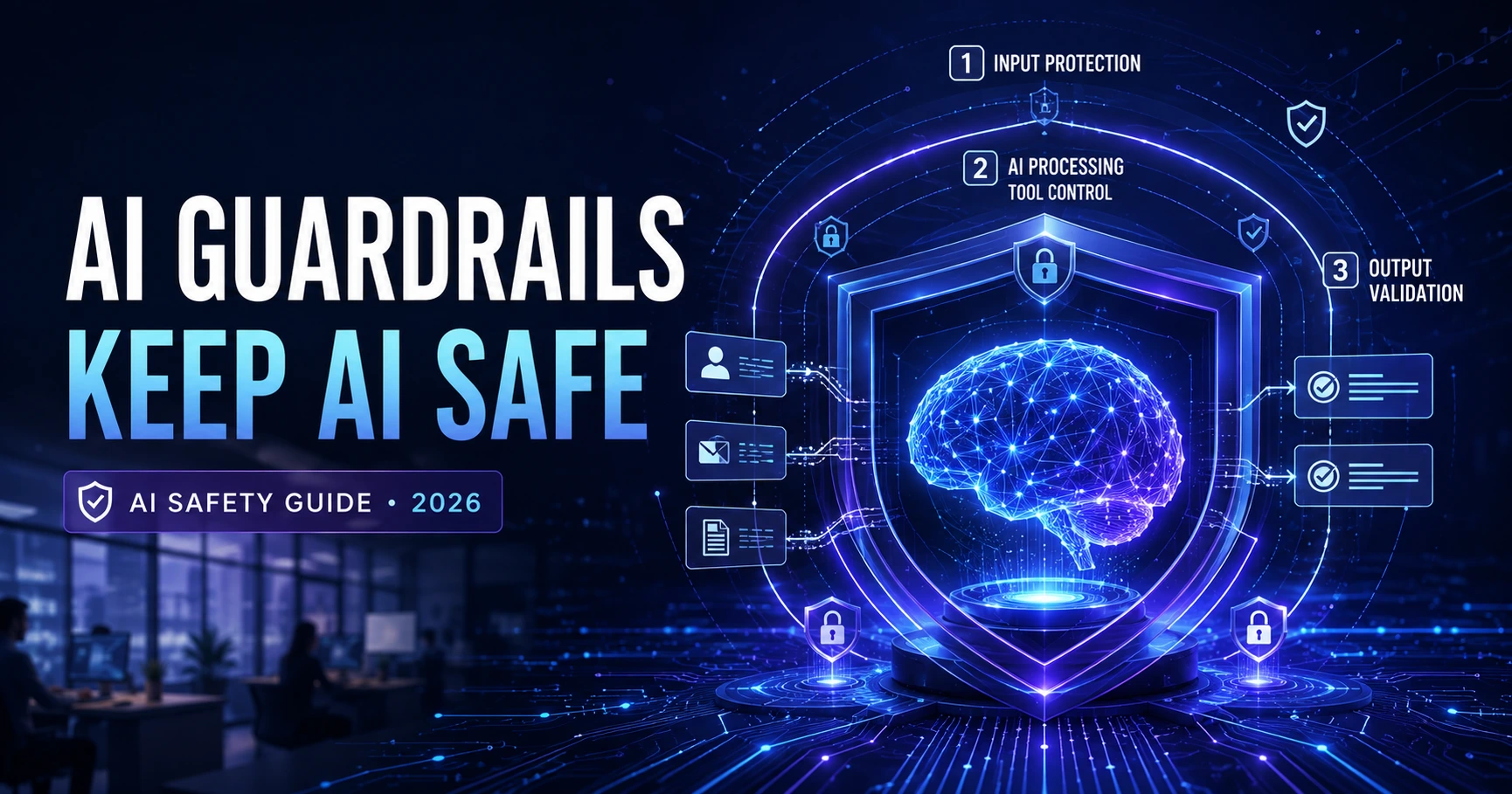
How AI Guardrails Work: The Three-Layer Model
Modern guardrail architecture operates across three distinct stages of every AI interaction. Experts often call this the "guardrail sandwich" - the user's message and the model's response are both wrapped in protective evaluation layers, with the model's core processing happening in the middle.
Layer 1: Input Guardrails (Pre-Processing)
Before a user's message ever reaches the core AI model, it passes through input guardrails - the first and most critical line of defence. These checks happen in milliseconds and include:
- Prompt injection detection: Scanning inputs for attempts to override system instructions or embed hidden commands, particularly in text fetched from external sources or user-supplied documents.
- Jailbreak pattern detection: Identifying known structures associated with attempts to manipulate the model through role-play scenarios, hypothetical framings, or multi-step reasoning exploits.
- PII redaction: Automatically detecting and masking Personally Identifiable Information - names, email addresses, social security numbers, financial account data - before it enters the model's context.
- Topic and intent classification: Checking whether the query falls within the application's defined scope. A customer service bot for a software company should not engage with medical diagnoses.
- Rate limiting and abuse detection: Flagging abnormally high request volumes from a single source, which may indicate automated vulnerability probing.
Layer 2: Processing Guardrails (Context & Tool Control)
For AI systems that access external tools, databases, or APIs - especially agentic systems - processing guardrails operate during the model's reasoning phase. They manage what the AI can access and act upon:
- Permission scoping: Ensuring the AI can only access data and tools that fall within its defined role and the user's authorisation level.
- Action sandboxing: Preventing agents from executing high-stakes or irreversible actions - deleting records, sending emails at scale, making financial transactions - without explicit human confirmation.
- Retrieval access control: In RAG systems, enforcing role-based access so the AI only retrieves documents the requesting user is authorised to view.
- Context window monitoring: Tracking what information has been injected into the model's context to detect potential data contamination from external sources.
Layer 3: Output Guardrails (Post-Processing)
Even after the AI generates its response, output guardrails evaluate it before delivery. This final checkpoint catches problems that slipped through input filtering:
- Hallucination detection: Cross-referencing factual claims against verified knowledge bases or flagging statements that exceed the model's reliable knowledge domain.
- Toxicity and bias screening: Evaluating responses for harmful, offensive, discriminatory, or otherwise unacceptable content using specialised classifier models.
- PII leak detection: A final sweep to ensure no sensitive information - from the user's input or the model's training memory - appears in the outgoing response.
- Policy compliance checking: Verifying the response adheres to business rules, such as always including a required disclaimer for financial content or recommending professional consultation for medical queries.
- Format and structure validation: Ensuring the response meets required specifications, especially important in automated pipelines where the output feeds directly into another system.
The 5 Key Types of AI Guardrails
Beyond the three processing layers, guardrails can be categorised by their functional purpose. Understanding these five types allows teams to design comprehensive safety systems that address every angle of risk.
Input Controls
Input controls validate every message before it enters the AI model. They use a combination of rule-based filters (pattern matching, keyword blocking), machine learning classifiers (for intent detection and injection scanning), and structural validators (checking format and length). Input controls are the fastest type of guardrail to run and the most cost-effective, since catching a problem before the model processes it avoids wasting expensive inference compute.
Common implementations: Content filters, PII detectors, topic classifiers, prompt injection scanners, language detectors, rate limiters.
Output Validation
Output validation evaluates the AI's response before it reaches the user. This is the final safety net for catching what input filters missed. Modern output validators often use a second, specialised "judge" model - a lighter AI trained specifically to evaluate the quality, safety, and accuracy of another model's outputs. This approach is slower than rule-based filtering but far more capable of catching nuanced problems: subtle bias, plausible-sounding hallucinations, or cleverly disguised harmful content.
Common implementations: Toxicity classifiers, hallucination detectors, PII leak checkers, factual grounding validators, brand voice compliance checkers, sentiment monitors.
Retrieval Controls
In systems using Retrieval-Augmented Generation (RAG) - where the AI fetches external documents to ground its responses - retrieval controls determine which information sources the model can access and which users can see which documents. This type is especially critical in enterprise environments where employees have different data clearance levels. Without retrieval controls, an AI assistant might surface a confidential legal document to an unauthorised user simply because the document was relevant to the query.
Common implementations: Role-based access control (RBAC) for knowledge bases, source allowlists and blocklists, document sensitivity classification, metadata filtering.
Agent & Tool Guardrails
As AI systems evolve into autonomous agents that can browse the web, write and execute code, send emails, manage calendars, or interact with external APIs, agent guardrails become essential. These controls restrict the scope of actions an AI can take without human approval, applying the cybersecurity principle of least privilege: the AI should only have permission to perform the minimum set of actions necessary for its defined task.
A travel-booking AI agent, for example, should be able to search for flights and return options - but it should require explicit human confirmation before making any actual purchase or sharing payment information with a third party.
Common implementations: Tool permission scoping, action confirmation workflows, human-in-the-loop checkpoints for irreversible actions, transaction limits, API call rate limits per session.
Policy Engines
Policy engines are centralised rule sets that enforce business-specific, legal, or regulatory requirements across an entire AI deployment. Unlike the other guardrail types, which are primarily technical, policy engines translate human-defined policies into machine-enforceable rules. A financial services company might use a policy engine to ensure the AI always includes a regulatory disclaimer when discussing investment products. A healthcare platform might enforce that the AI always recommends consulting a licensed physician before any medical decision.
Policy engines bridge the gap between compliance teams and AI engineering teams, allowing non-technical stakeholders to define safety requirements that are enforced automatically at scale.
Common implementations: Business rule engines, compliance policy libraries, automated disclaimer insertion, competitor mention blocking, geographic content restrictions.
AI Guardrails vs. AI Alignment: What's the Difference?
These two terms are frequently confused, but they describe fundamentally different approaches to AI safety, operating at different stages of the AI lifecycle.
| Aspect | AI Alignment | AI Guardrails |
|---|---|---|
| When it operates | During model training | During live deployment (runtime) |
| What it targets | The model's core values and goals | Inputs, outputs, and agent actions |
| How it's implemented | RLHF, Constitutional AI, fine-tuning | Filters, classifiers, policy rules, monitoring |
| Who controls it | AI model developers (OpenAI, Google, Anthropic) | Businesses deploying the model |
| Updateable without retraining? | No - requires full model retraining | Yes - can be updated in real time |
| Best analogy | A person's upbringing and personal values | The rules and policies of a workplace |
The critical takeaway is that alignment and guardrails are not competing approaches - they are complementary. Alignment shapes what the model wants to do; guardrails constrain what the model is allowed to do. Both are necessary because neither is sufficient alone. A perfectly aligned model can still be manipulated by a determined adversary. And a model with excellent guardrails but poor alignment training might look for ways to work around those constraints if they conflict with its learned objectives.
Real-World Examples Across Industries
Understanding guardrails in the abstract is valuable, but seeing how they function in specific industries makes their importance immediately tangible.
🥠Healthcare
A healthcare platform using an AI assistant to answer patient questions faces some of the most demanding guardrail requirements in any sector. Clinical accuracy is non-negotiable - an incorrect statement about medication dosages or drug interactions could cause serious harm. Output guardrails check every response against approved clinical documentation, flag any statement that exceeds the model's certified medical knowledge boundary, and automatically append recommendations to consult a licensed physician for any actionable medical decision.
Input guardrails in healthcare must simultaneously protect PHI (Protected Health Information) under HIPAA. Any patient data mentioned in a query must be detected, masked, and handled according to strict compliance requirements before it enters the processing pipeline. Healthcare AI without these controls is not just risky - it is legally indefensible.
💰 Financial Services
In banking and investment, AI tools must operate under guardrails designed to prevent regulatory violations. An AI financial assistant cannot make personalised investment recommendations without the appropriate disclosures, even if a user directly asks "what should I invest in?" Policy engine guardrails automatically insert required regulatory disclaimers, restrict the AI to discussing general financial concepts rather than personalised advice, and flag queries that cross into regulated advisory territory for escalation to a licensed human adviser.
Retrieval controls are equally vital: an AI used by bank employees must enforce that customer account data is only surfaced to employees who have authorisation to view that specific customer record. A single retrieval control failure in this context can constitute a serious data protection breach.
🛒 Customer Support
E-commerce and SaaS companies deploying AI customer support agents face a different category of risks. A customer support AI without guardrails might spontaneously offer refunds that violate company policy, provide incorrect information about product availability, promise delivery timelines that are operationally impossible, or discuss competitors in ways that create legal liability.
Topic restriction guardrails keep the AI focused on its designated function. Business policy guardrails prevent the AI from making any commitment - a refund, a discount, or a service promise - that has not been explicitly authorised. This does not make the AI less helpful; it makes it consistently reliable and legally safe to operate at scale.
âš™ï¸ Enterprise Automation
Organisations using AI agents to automate complex workflows - scheduling, data entry, supply chain decisions, or IT management - face the most demanding agentic guardrail requirements. These systems can take sequences of actions across multiple tools, and a single misguided decision can cascade into significant operational damage.
In enterprise automation contexts, guardrails enforce least privilege: the AI can draft an email but cannot send it without approval; it can suggest a purchase order but cannot submit one above a defined value threshold; it can read a database record but cannot modify or delete it without explicit human instruction. Every high-stakes action has a required confirmation checkpoint built in.
How Organisations Implement Guardrails
From a practical engineering standpoint, guardrails are implemented using a layered stack of techniques selected based on the required speed, accuracy, and cost of each safety check.
Rule-Based Filters - Fast and Deterministic
The simplest and fastest guardrail layer uses rule-based filters: deterministic checks for specific patterns. These include keyword blocklists, regular expressions for PII detection (phone numbers, email addresses, credit card patterns), and topic allowlists that accept only queries matching predefined categories. Rule-based filters add only milliseconds to response time and are extremely cheap to run. Their weakness is brittleness - a creative user can often rephrase a harmful request to bypass a keyword filter.
ML Classifier Models - Accurate and Adaptive
Machine learning classifiers are smaller, specialised models trained to detect categories of risk: toxicity, prompt injection, off-topic requests, or hallucinated claims. Unlike rule-based filters, classifiers understand context - they can recognise a problematic request even when it contains no explicitly blocked keywords. Many organisations use open-source classifiers from Hugging Face's safety toolkit, or purpose-built commercial platforms like Guardrails AI, LLM Guard, or Lakera Guard.
LLM-as-Judge - Nuanced and Context-Aware
For complex output evaluation, organisations use a second language model to evaluate the primary model's response before delivery. The judge model receives a specific rubric (evaluate for accuracy, policy compliance, tone) and returns a structured assessment. This approach catches the most subtle problems but adds significant compute cost and latency. Smart implementations run cheap fast checks first, escalating to the LLM judge only when secondary warning signals are triggered.
Human-in-the-Loop Oversight - Essential for High-Stakes Actions
For the highest-risk applications, automated guardrails are augmented with human review at defined checkpoints. Platforms like Salesforce Agentforce and similar enterprise AI tools build human approval steps directly into agent workflows, creating a hybrid system where AI handles routine decisions autonomously and humans retain control over consequential, irreversible actions.
Limitations and Ongoing Challenges
For all their importance, AI guardrails are not a perfect solution. Researchers, engineers, and AI safety professionals are actively grappling with a set of persistent challenges.
The Jailbreaking Arms Race
Every guardrail system faces an ongoing dynamic with adversarial users. As soon as a bypass technique is patched, new variations emerge. Research has consistently shown that even sophisticated multi-layer guardrail systems can be circumvented through sufficiently creative prompt engineering - fictional framings, multi-step role-play scenarios, encoding instructions in unusual character sets, or translating commands through multiple languages. Adversarial robustness remains an active and unresolved research problem.
The False Positive Problem
Overly aggressive guardrails create a mirror-image problem: they block legitimate, harmless requests. A medical information tool that flags every question about medication as a prohibited clinical query will frustrate users with completely reasonable questions about drug interactions with common over-the-counter products. Calibrating guardrails to catch genuine threats without blocking normal use requires extensive real-world testing, careful threshold tuning, and ongoing monitoring - a perpetual engineering challenge.
The Agentic Gap
Traditional guardrails were designed for conversational AI - a single message in, a single response out. Agentic AI systems, which take multi-step actions across multiple tools over extended sessions, create a fundamentally different threat surface. An agent might take ten individually acceptable actions that combine to produce an outcome no single guardrail check was designed to anticipate. The field of agentic safety is still emerging, and current guardrail frameworks are actively being extended to address this gap.
Latency and Compute Cost
Comprehensive guardrails add processing time and computational cost to every interaction. In consumer-facing applications where speed is critical to user experience, the latency added by multiple evaluation layers - especially LLM-as-judge - can be prohibitive. Engineering teams must constantly balance thoroughness against performance, typically designing tiered systems where most requests pass through fast, cheap checks and only edge cases escalate to expensive evaluations.
The Multimodal Challenge
As AI systems increasingly handle images, audio, video, and code alongside text, guardrails must extend across all these modalities simultaneously. Detecting harmful content embedded in an image, identifying manipulated audio in a voice AI interaction, or evaluating the safety of AI-generated code requires entirely different technical approaches. Maintaining consistent safety standards across a multimodal AI deployment is significantly more complex than protecting a text-only model.
The Future of AI Guardrails
The AI safety landscape is evolving rapidly, and the guardrail systems of 2026 are already far more sophisticated than anything available just two years ago. Several key trends are shaping where this technology heads next.
Contextual Intelligence Over Keyword Filtering
The industry is shifting away from rigid, pattern-based perimeter security toward guardrails that understand intent and context rather than just blocking specific words or phrases. Next-generation guardrail systems will evaluate the full context of a conversation, the user's established role and permissions, and the potential downstream consequences of an action before deciding whether to permit or intervene. This move from "does this contain flagged content?" to "could this cause harm in this specific context?" represents a fundamental maturation of the field.
Embedded Reasoning-Level Controls
Rather than external filters wrapping a model, researchers are exploring ways to embed safety reasoning directly into the model's inference process - so the model itself evaluates each step of its reasoning chain against safety criteria before acting. This approach, demonstrated in Anthropic's Constitutional AI work, moves safety from the perimeter to the core of the model's decision-making loop, making it far harder to bypass through clever prompt engineering.
Regulatory Standardisation
The EU AI Act has created the first binding legal framework for AI safety requirements, and similar legislation is advancing rapidly in the United States, United Kingdom, and across Asia-Pacific. This regulatory pressure is driving the standardisation of guardrail requirements - similar to how cybersecurity compliance frameworks like SOC 2 and ISO 27001 standardised security practices across industries. AI safety certifications are likely to become a baseline requirement for enterprise software procurement within the next several years.
Open-Source Guardrail Ecosystems
The rise of open-source guardrail frameworks - NVIDIA NeMo Guardrails, Guardrails AI, Lakera Guard, and LLM Guard among them - is democratising access to production-grade AI safety infrastructure. Small and medium businesses that previously could not afford custom safety systems can now implement robust, well-maintained guardrails using community-supported tools, accelerating responsible AI adoption across the entire industry.
The Bottom Line on AI Guardrails
AI guardrails are not an optional add-on for organisations deploying artificial intelligence - they are a foundational requirement for responsible, sustainable, and legally compliant AI use. As AI systems grow more powerful and more autonomous, the importance of maintaining robust, layered safety controls only intensifies.
The good news is that guardrails are no longer an exotic capability accessible only to large AI labs. A mature ecosystem of tools, frameworks, regulatory guidance, and community best practices now exists to help organisations of all sizes implement effective AI safety controls. The companies that invest in this infrastructure today are the ones that will deploy AI with genuine confidence and earn lasting user trust.
The highway guardrail did not slow the car down - it made the highway safe enough to drive fast. That is exactly what well-designed AI guardrails do for artificial intelligence: they do not diminish the technology's power; they create the conditions under which that power can be used responsibly, at scale, and with accountability.
Frequently Asked Questions
What are AI guardrails?
AI guardrails are technical and policy-based safety mechanisms that govern how an artificial intelligence system behaves during live use. They intercept user inputs before reaching the model, monitor the model's processing, and validate the AI's response before delivery. The goal is to prevent harmful outputs, data leakage, factual errors, policy violations, and misuse - without limiting the model's genuine usefulness.
How are AI guardrails different from AI alignment?
AI alignment shapes the model's core values and goals during training using techniques like RLHF (Reinforcement Learning from Human Feedback). AI guardrails operate at runtime as external controls applied during live deployment. Both are complementary: alignment shapes what the model wants to do, while guardrails constrain what it is allowed to do. Neither is sufficient alone - effective safety requires both.
What are the main types of AI guardrails?
The five main types are: (1) Input controls that filter and validate user prompts; (2) Output validation that evaluates AI responses before delivery; (3) Retrieval controls that govern what data sources a RAG system can access; (4) Agent and tool guardrails that restrict what actions autonomous AI agents can take; and (5) Policy engines that centralise and enforce business-specific or regulatory requirements across an entire deployment.
Can AI guardrails be bypassed?
Yes, basic guardrails can be bypassed through prompt injection or jailbreaking techniques. This is why modern implementations use a layered defence-in-depth approach - combining lightweight rule-based filters, ML classifiers, LLM-as-judge evaluation, and human oversight. Bypassing one layer should not compromise the entire system. Adversarial robustness remains an active and unresolved area of AI safety research.
Why do AI guardrails matter for businesses?
For businesses, AI guardrails are both a legal and operational necessity. Without them, organisations face data privacy breaches, regulatory non-compliance (GDPR, HIPAA, EU AI Act), brand damage from harmful AI outputs, and costly errors from autonomous agents acting outside their intended scope. Guardrails are what allow companies to deploy powerful AI at scale with genuine confidence and accountability.
What is a prompt injection attack and how do guardrails stop it?
A prompt injection attack embeds hidden instructions inside a user's message or external data source to override the AI's safety rules. Input guardrails defend against this by scanning inputs for suspicious instruction patterns, sanitising text retrieved from external sources, and using ML classifiers specifically trained to detect injection attempts before they reach the core language model.

Jitendra Patra
AI Researcher & Software Engineering Student
Jitendra Patra is a software engineering student and AI researcher who writes in-depth guides on artificial intelligence, AI safety, and prompt engineering. He covers topics like AI guardrails, large language model behaviour, and responsible AI deployment practices.
His work focuses on making complex AI concepts accessible - from how guardrails work at a technical level to how businesses can implement them responsibly in 2026.
This guide is developed from synthesised research across published frameworks from IBM, NIST, Anthropic, Salesforce, and the broader AI safety community.